

Students will notice a more accessible Blackboard experience in the upcoming semesters.
The U.S. Department of Justice issued a Title II digital accessibility rule for public entities in 2024.
Public colleges are affected by the ruling including our university Texas A&M University-San Antonio.
Staff and faculty at Texas A&M University-San Antonio have learned to modify lesson materials and digital content to become more accessible.
Ben Gerhardt, instructional designer III for the Center for Academic Innovation, has been working on the federal ADA requirement in the center with faculty and staff members.
“All course content has to be fully ADA compliant, which requires faculty and staff to make everything accessible,” Gerhardt said.
The Center for Academic Innovation on campus collaborates with faculty to succeed in “learning, teaching and technological integration” according to the center’s website.
Blackboard Ultra is the new modernized technology replacing the previous Blackboard interface that some faculty members are currently using.
The transition is expecting faculty and staff to learn new methods for ensuring course content meets accessibility guidelines and to learn new technology features in Blackboard Ultra.
Sarah Harper, assistant professor of criminology and digital accessibility faculty fellow, is assisting campus staff and faculty to learn the new technology changes.
There are both positive and negative reactions from staff and faculty about the transition. Previous course content needs to be modified to pass the accessibility requirement.
“It is tech embracing versus tech resistant,” Harper said. “Some have used other tools before, and others who have gone through training wish it was more efficient.”
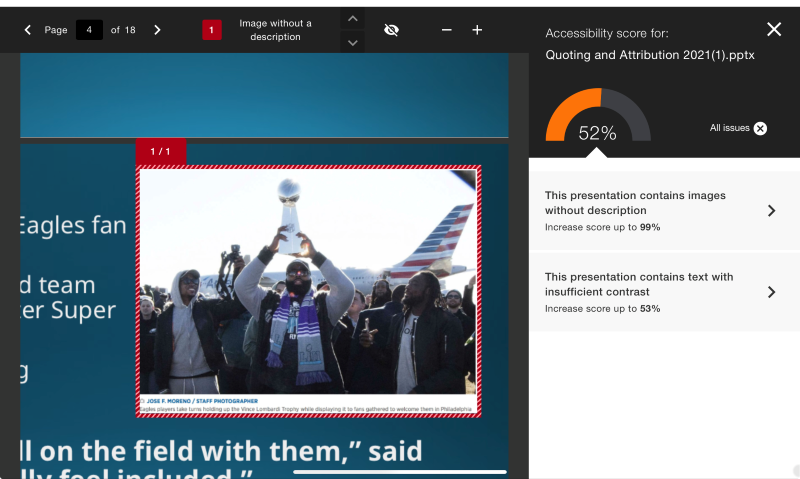
Any items uploaded to Blackboard are examined by an accessibility tracker that shows the faculty a percentage of how accessible the content is. Ideally the content needs to meet a score of 90 percent or higher.
Harper said it can be difficult finding a properly captioned YouTube video to show in her Crime and Justice in Pop Culture class. Videos need to have accurate captions for the viewer and sometimes certain videos have mistakes in captioning.
Another challenge is changing older PDF files to the proper accessibility guidelines. Screen readers might not read all of the text on a PDF file or website, according to the Civil Rights Compliance Office at the University of Washington.
“For example, blind individuals may rely on screen readers to interpret visual information on a website,” states the office. “However, if a website lacks alternative text to describe the image, these users cannot access publicly available information.”
The law makes educators adjust class materials for students and find materials that better meet the needs of students. Access barriers will be eliminated as much as possible through this process.
Harper had received accommodations as a student throughout her college experience, which allows her to be passionate about the transition and assisting in this project. Accommodations range from interpreters to extended deadlines for those who need it.
College students with a disability make up about 21% of students in the United States as of 2020. Expanding the ADA compliance assists students who request accommodation services.
The deadline for the requirements to be complete is April 24.
Equality for all students is the ultimate goal.
“Things that matter a lot to me are access to justice and being collegial. We are in this together and we succeed when our entire team succeeds,” Harper said.
This story was updated March 30, 2026, to correct a date in the photo cutline.