Rolando Morales
Managing Editor



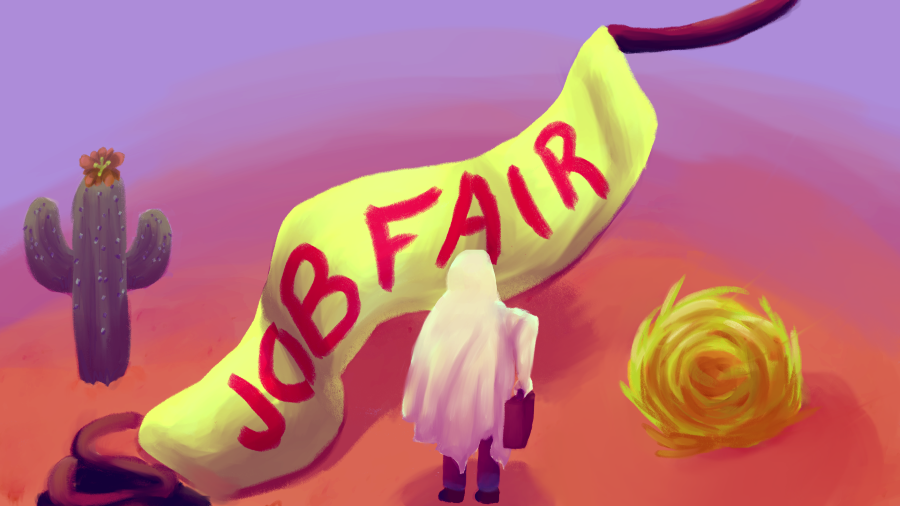
Nearly 90% of employers plan to hire new college graduates, according to the National Association of Colleges and Employers, making career fairs an important resource for students seeking internships and full-time employment. Photo illustration by Nicky Haskins
Amid a challenging job market, students face hurdles landing jobs months after graduation. In many cases, job applications go unanswered, leaving them with no response from potential employers.
In this highly competitive market, they don’t even get a rejection letter.
Graduates are constantly getting ghosted, which Philip Roth explains in his recent study, “Post-Interview Ghosting Casts Dark Shadows on Applicant Reactions.”
Roth, Trevillian Distinguished Professor in the Wilbur O. and Ann Powers College of Business at Clemson University, said ghosting is becoming a common part of job hunting, adding that employers cut ties with their applicants pretty often. Roth will present his study July 31-Aug. 4 at the 86th Annual Meeting of the Academy of Management in Philadelphia.
Karen Martin, director of Career Services at the Mays Center for Experiential Learning at Texas A&M University-San Antonio, said one of the biggest misconceptions students face is believing a college degree alone is enough to secure a job after graduation.
“Yeah, so challenges students face after graduation. I would say we see a lot of students who believe that all they need to be successful in the workforce is a college degree,” Martin said.
Martin said students also need to have the ability to talk about their skills.
“And really, it’s a college degree, but you also have to know how to talk about your skills,” Martin said. “The skills you developed in your degree plan, or maybe skills you developed in jobs you’ve had, or internships, volunteering, student orgs, like, kind of all the things that have been a part of the college experience.”
She said it helps to connect experiences to the qualifications employers are seeking as the job market is very competitive.
“And connect that to what the employer that you’re hoping to work for or the industry you want to be in,” Martin said. “Making those connections is really on the graduating students. And I don’t think enough students know that. So it’s a competitive workforce right now.”
Martin described eight competencies job seekers need to stand out to employers.
“So the eight competencies are… career and self-development, so having an idea of what you want to do, and learning the skills you need to learn to get there,” Martin said. “They also want to see leadership skills. Communication skills is the third one. Professionalism. So, can you, you know, act appropriately in a professional environment. They want to see critical thinking. Teamwork is No. 6. Equity and inclusion are No 7, and technology skills are No. 8.”
Martin encouraged students to have a clear idea of what to do with their degree and to begin gaining relevant experience before graduation.
“The students that I see most successful are the ones who know generally what they want to do with their degree, and they have tried to get experience that connects to the skills that they’ll need in that job,” Martin said.
Martin said career fairs are a great opportunity for students to connect with employers and increase their chances of securing interviews.
“We do, like, 13 in an average year for students,” Martin said. “And one of the reasons we know it’s important is it gives students and alumni the opportunity to get in front of these employers who are deciding who gets to come in for an interview.”
Because many graduates now spend six months or longer searching for full-time employment, Martin recommends beginning the job search early.
“So, for most college graduates, it’s taking up to six months or more to find a full-time position. So, I would say for our seniors, I would start at the beginning of their senior year, right? So, if they started in August, a lot of hiring is happening in the fall,” Martin said.
She also encouraged students to attend a career fair that best suits their interests.
“I would recommend, yeah, starting really strong in September, coming to the career fair that we’ll have at the end of September, or finding the career fair that would be the right fair for that student’s interest,” Martin said.
Martin also conducts a yearly survey called the First Destination Survey, which asks graduating students about their post-graduation plans. Last year, 674 graduates responded.
Of those respondents, 674 planned to work, 93 said they were still job-hunting and 98 planned on continuing education. Fewer graduates mentioned the military or volunteering.
The survey also identifies the top employers of recent graduates. Martin said H-E-B is No. 1, followed by the City of San Antonio, Northside ISD, Bexar County and Southwest ISD.
Career Services does not track which companies are not hiring.
“We don’t always know who’s not hiring students unless students tell us,” Martin said.
According to the Federal Reserve Bank of New York, as of March 2026, the unemployment rate is at 5.6% for recent college graduates ages 22-27, 3.1% for all college graduates and 7.2% for young workers. By comparison, in July 2025, the unemployment rates were 5.0% for recent graduates, 2.8% for all graduates, and 7.1% for young workers.
She also said AI is taking positions such as data entry, as it can complete the job faster than a human.
“I don’t see too many of those jobs — but if it was just your job to take something from a spreadsheet and put it into a graph format, and that was really the basis of the job, now AI can do that in a split second. And so those kind of jobs, I think, will eventually not exist because of AI,” Martin said.
While Martin offered advice based on years of helping students prepare for the workforce, recent graduates said persistence, internships and networking helped them navigate today’s competitive job market.
Christian Meza, public relations and broadcast assistant for the San Antonio Missions Baseball Club, said one of the biggest challenges after graduation is staying motivated when job applications go unanswered or denied.
“I think the challenge is just more like trying to be consistent, even when you reach out to multiple jobs and then they don’t reach out back to you, or even if you get denied a position,” said Meza, who graduated from A&M-San Antonio in December 2025 with a communications degree. “I think the challenge of that is still trying to not let that get to you and stay consistent within that job search.”
He said graduates should expect the job search to take time and not to become discouraged by rejection.
“Another challenge is just finding a job right away,” Meza said. “A lot of patience is necessary, and same thing, just you gotta stay persistent and consistent with the job search; you can’t really let that defeat you in a way, especially right after college.”
Meza started applying to jobs right after graduation, as many employers required a bachelor’s degree with 2-3 years of experience, which he did not have. However, Meza did complete an internship at the Bandera Bulletin in the summer of 2025, where he photographed events, wrote stories and edited his own work.
“I think the skills that I learned, I just got to polish up more of my photography skills, and I got to be more independent,” Meza said.
He encouraged students to continue applying for positions, follow up with employers and make sure their resumes highlight relevant experience.
“Staying committed to being persistent in the job search, putting your name out there, even if after you applied, email the supervisor, email whoever you gotta get in contact with, and really polishing your resume. As long as you summarize the key skills and highlights of your resume,” Meza said.
Meza also reminded graduates to sell themselves in interviews.
“For example, when someone asks you why you want this job, and you’re like ‘Oh, I went to college to study this, and I wanna learn more.’ The response should be more of like ‘Why they should hire you?’ ‘What do you bring to the table?’ Meza said.
Networking can also help applicants stand out, he said.
“Connect with people on LinkedIn, put your name out there cause no one’s gonna do it for you,” Meza said. “Ultimately, you know, so you wanna get noticed, or you want a reply to that job application. You gotta put yourself out there, and also when an opportunity comes knocking, sell yourself as much as you can.”
Nyla Aguilera, a communications senior, also advises graduates to check Handshake, a job board for college students, as often as possible to look up internship opportunities.
“So I started looking in Handshake,” Aguilera said. “I just search up potential internships that would help me or benefit me in the future or would look good in my resume.”
She said internships can help students gain experience while networking with professionals.
“I would recommend doing internships as much as possible, even if they’re not paid, when you get a lot of experience of that, and then just networking with the right people will get you into the right doors,” Aguilera said.
Another piece of advice that Aguilera gave is to stay consistent when applying for a job.
“By being consistent, I guess. I think you can’t really beat the fact that the job market is not the greatest right now,” Aguilera said. “So I think just being consistent within applying to jobs and not applying to whichever job.”
Aaron Flores, investment specialist at J.P. Morgan and a graduate of the university’s 11-month MBA program at A&M-San Antonio, said networking played a major role in helping him secure a job.
Flores received a job offer after meeting a company representative during the MBA program’s business etiquette dinner and interviewing with the company shortly afterward.
“You have to market yourself at the end of the day,” Flores said. “It’s not grade school. They’re not gonna go up to you and be like, ‘Hey, are you still interested?’”
Rachel Pelayo, employment operations manager at Southwest Research Institute, said students should research organizations before applying to ensure their skills and values align with the employer’s mission.
“We encourage all job seekers to consider an organization’s mission and core values before applying,” Pelayo said.
She said it is also important for applicants to advocate for their goals and present themselves honestly through the hiring process.
“It is imperative to always be authentic in your resume and your interview,” Pelayo said. “This will benefit the student in presenting themselves for who they are and their personal goals.”
Pelayo also advised applicants to be polite, respectful and timely with every interaction they have with potential employers.
While employers look for candidates who are prepared and authentic, Martin said students don’t have to navigate the job search alone.
“We want to know you. We know your story is different from every other student, and so it’s important to us to see you as the individual that you are,” Martin said.
She said Career Services helps students navigate and develop the tools they need to compete in today’s job market.
“We want to take all of those modern career dynamics that you may or may not know, and teach you what those are, because it’s hard to compete and do the things we’re talking about, like having a modern resume that’s competitive,” Martin said. “It’s hard to do without help, so that’s the serve part. We want to serve and make sure you’re prepared.”