

In its first year, the marketing minor at Texas A&M University-San Antonio is already drawing interest from a wide range of majors and giving students hands-on experience that professors say can apply far beyond the business world.
Faculty say the new minor has attracted students from both inside and outside the College of Business, including communications, accounting, finance, computer science and public health students who want to better understand how organizations reach consumers, develop strategy and promote ideas.
The marketing minor was introduced by Professor Arne Baruca, interim department chair of Management and Marketing.
“We introduced the minor last year because we only offered one minor in the College of Business,” Baruca said.
Baruca said the marketing minor was created as a way for communication students to earn the additional hours they need to graduate while also choosing a field that connects well with their major.
There are 57 students minoring in marketing.
The minor requires 18 credit hours, including three core courses and three electives.
Core classes include Principles of Marketing, Consumer Behavior and Marketing Research.
Camilla Montoya, lecturer of marketing, said one of the biggest surprises for students has been discovering that marketing involves much more than advertising.
“They learned a lot more than they expected that they would learn. Students now realize that marketing is more than advertising and promotion,” Montoya said.
Montoya said students often assume marketing is only about campaigns or social media, but they leave with a broader understanding of how business decisions are made.
Marketing involves self-branding, pricing, distribution, promotion, supply chain decisions and understanding how all of those support an organization’s overall mission.
That broader perspective is one reason students from other majors have responded positively to the new program.
“The classes have been good so far. It’s good to know that what they’re teaching in the courses is actually relevant in the real world,” Isabella Nava, business management sophomore, said in an interview April 15.
Nava said Montoya is an effective professor who clearly cares about helping students understand the material.
“You can tell she tries to diversify her coursework and use group work to make sure you understand it, not just from the textbook, but also how to apply it, which I appreciate, because I feel like a lot of times it’s memorize and regurgitate in some classes,” Nava said.
Montoya said some students who originally enrolled in marketing courses to satisfy minor requirements have even begun reconsidering their major and have thought about switching it to marketing.
Roberto Saldivar, assistant professor of marketing, said the minor’s value comes from how widely its lessons can be applied.
“I think students within the College of Business and outside can benefit from having some experience within marketing because of how we live and how our society works. Having a healthy understanding of these practices just makes everybody a better consumer,” Saldivar said.
“The skills can be applied to anything, whether somebody is studying healthcare, who maybe wants to start their own organization, someone who is in science or engineering, who is coming up with a new product or idea and needs to understand the consumers that may want to purchase or organizations that might be willing to take a chance on them,” Saldivar said.
Faculty also say the program has emphasized real-world learning during its first year.
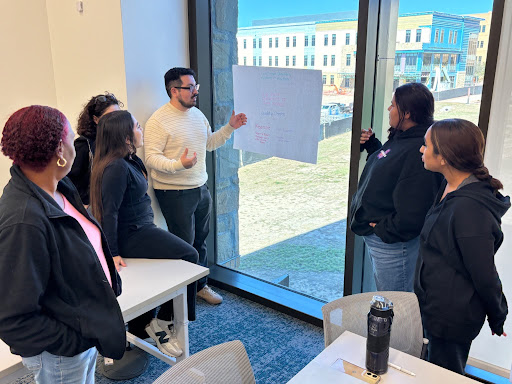
In one project created by Montoya, students worked in groups with local small businesses and microbusinesses to build marketing plans instead of creating hypothetical companies.
Last semester alone, students helped 61 different businesses in the community, including some owned by students themselves.
As part of the project, students conducted SWOT (Strengths, Weaknesses, Opportunities, Threats) analyses, identified business objectives and developed strategies tailored to their clients’ needs.
“We’re not here just to teach classes for the sake of teaching class; we’re here to help students grow and develop their own business or their talents to then apply and help their career and their community,” Montoya said.
Those projects have also created opportunities beyond the classroom.
Montoya said connections with local businesses have led to internship opportunities for students receiving course credit this summer, including positions with a senior citizen facility and with a startup company, your2ndbrain.ai.
In one case, a student who worked with an organization during a class project will continue with that company as an intern after building a strong relationship with its marketing director.
At the same time, professors say the coursework challenges students to develop teamwork and leadership skills.
Montoya said students often have to work through the “storming” stage of group dynamics before they can perform effectively. The storming stage is a critical phase where team members disagree on goals, leadership, and work styles that can cause performance to drop.
Montoya said those growing pains can lead to confidence, leadership and even lasting friendships.
“If you’re able to connect with others, to relay your message, to be confident in what you’re doing and especially have critical thinking, that’s what’s going to get you to succeed,” Montoya said.
For students still considering whether to add the minor, Saldivar’s advice was simple: “Do it. Just do it. If you have the opportunity to do it, I highly encourage it.”
He said the program can complement nearly any major, but students should also think carefully about how it fits into their long-term goals.
Monserrath Bedolla, communications junior, said she chose the minor to further her skills and knowledge in sports marketing.
Bedolla eventually wants to manage social media pages for professional sports teams, specifically the Los Angeles Football Club, LAFC.
“I hope to have a better understanding of consumer behavior, because I feel like you have to know what people want, and applying it to sports, you have to understand what the fans want,” Bedolla said.
As the minor completes its first year, faculty say its early success shows that marketing is not only useful for future marketers, but for any student who wants to understand consumers, communicate ideas and navigate an increasingly digital world.