Rolando Morales
Assistant Editor




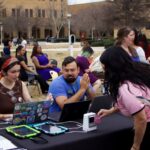
Students study in Central Academic Building 202 on Mar 4. Photo by Nicky Haskins.
In the midst of midterms week, three tutors from the Texas A&M University-San Antonio Academic Learning Center shared their study and test-taking tips.
Demetrio Deanda, tutor at the center and computer science senior, advises students to give themselves time on each question and not rush.
“I know that some students function in a way that, if they study last-minute, it stays fresh in their minds,” Deanda said. “You need to figure out which is your best strength. So, studying last minute, if it helps you, go for it, but if you need the time to go over each question, give yourself that time, I would say, like a week in advance.”
It also helps students to expose themselves to a testing environment and to do mock exams frequently. That way, students don’t freeze when taking the test.
Repetition helps Hugo Juarez, a tutor at the center and a computer science senior with a focus on cybersecurity. When he studies, he retakes older quizzes and uses AI to give him the answers to the questions. He also memorizes them.
“For me, it’s like repetition,” Juarez said. “Like, I do a lot of repetition, you know, quizzes or other material that you had previously. I do them all over again, I mean, sometimes I use AI to give me that question.”
Augustine Perez, who also tutors at the center, computer science senior, said he likes to get the test or assignment done when it’s first given.
“Studying a day before works, but studying as soon as the assignment is given is really good for me. Get it out of the way. You’re like, ‘Oh, I already know this stuff. I’ve gone over it a million times,’ just like your repetition,” Perez said as he gestured to Juarez during an interview March 2, at the center. “It’s a little bit of both.”
Deanda has a routine for studying and advises not to overstudy in one sitting to avoid burnout.
“You can try routines, 30 minutes studying, five-minute break, so that way, when you’re doing hardcore studying, you don’t burn yourself out,” Deanda said.
What helps Deanda take tests is that before the test, he tries to spend at least five to 10 minutes doing nothing.
“Sometimes, if you’re studying too much, you give yourself anxiety, and that can build for blanking during the exam, and then while you’re taking your test, if you do blank, don’t panic. Just go on to the next question and come back to it later,” Deanda said.
Juarez said moving on to another question might help answer the other question.
“Don’t spend too much time if you don’t remember it, because another question might either remind you or might give you part of the answer for that question,” Juarez said.
Deanda encouraged students to review the answers after finishing, especially if the question is open-ended, so that it’s easier to catch any mistakes.
For open-ended questions, he advised students to try answering them no matter what.
“If it’s open-ended, even if you know just a little bit, write something, because a lot of times they will give you partial credit,” Juarez said.
Juarez also pointed out that it’s important for students not to second-guess themselves because it may have been right the first time.
Perez explained that taking deep breaths during a test helps relieve anxiety.
“I think as long as you like, you study early, any interval that works for you,” Perez said. “I like to breathe. If I’m, like, freaking out, I’m not gonna do good on the test. And then just, you know, if you studied, you did all those steps, you just try your best. That works so well.“
Deanda wants to let students know that even if they don’t perform well on an exam, they shouldn’t let it get the best of them.
“There’s gonna be times where you don’t do so great on your exam,” Deanda said. “Don’t take it so hard. You’ll be bummed out about it, but don’t let it stick with you. Just learn from it and move on. It helps you grow.”
The Academic Learning Center is in Room 202 of the Central Academic Building. Hours are 8 a.m. to 6 p.m. Monday-Thursday and 8 a.m to 5 p.m. on Friday.