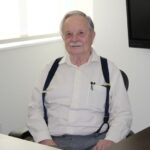


A former faculty member hosted a workshop to improve photography skills with a cell phone on Nov. 7 at Texas A&M University-San Antonio.
Jerry Townsend, a retired communications professor from A&M-San Antonio, led the workshop to share his knowledge and experience using cell phones for photography.
“I think that as time goes along, people who do journalism are asked to do more than write,” Townsend said. “Particularly because the internet and the immediacy that it demands, cell phones are the best tool to do work.”
He is responsible for setting up some of the equipment and furniture in the Jaguar Student Media lab at A&M-San Antonio now. Townsend said he “did all of the infrastructure, basically.”
Townsend lives in Oregon but visits Texas once a year and still feels a connection to A&M-San Antonio.
Townsend first started practicing photography with a coworker, Bruce Anderson. They sold wedding photos and started a business called T&A Photography. Then, he became a high school teacher and from there, a college professor at five institutions before retiring.
As attendees arrived, they received two lens cleaning cloths and a handout containing a photo editing checklist and a QR code that allowed them to download six workshop practice editing photos.
The audience consisted mainly of students majoring in communications and faculty or staff members from the communications program who knew Townsend.
“I wanted to learn how to be better with my phone camera, I – really – I’m always looking to improve my camera skills in general,” said Nicky Haskins, a communications senior. “It’s also extra credit and I really do need the extra credit and it lined up perfectly. It’s one of the few days I’m on campus, on a Friday so it’s like, yeah, (I’m going to) be here anyways.”
The workshop began with a brief introduction of Townsend, followed by his asking the audience for their usual struggles when taking photos on their cell phones.
After answering the questions from attendees, he explained which camera settings on a cell phone should be turned on or off for better quality photos as well as what features to change in the camera application.
He listed a few cell phone models that have a reputation for having good cameras, such as the Google Pixel and the Samsung 25.
“What is the best camera?” Townsend said. “The one you have with you.”
Throughout the workshop, the audience remained focused on Townsend’s words and delighted by his casual jokes.
He taught a few photography rules, such as the rule of thirds. This refers to keeping the object of attention on a specific third grid line.
He also demonstrated a few tools that some videographers and photographers use, such as a tripod and an attachable shutter-release button for a cell phone.
“Fooling around is a good thing,” Townsend said. “That’s how you learn.”
Townsend demonstrated his step-by-step process of editing on a cell phone application called Snapseed. He provided a checklist for the audience to follow along as he explained every step.
Haskins said he had never edited a photo using a cell phone app.
At last, Townsend instructed the audience to practice editing photos themselves with the photos he had provided ahead of time. He emphasized that making mistakes and playing with settings is a good thing.
During this time, the audience laughed and participated by assisting him with equipment or asking questions.
Haskins said he enjoyed the editing activity.
“I’m a very hands-on person, so it was fun,” Haskins said.
After concluding the workshop, most of the audience stayed to chat with Townsend. Those who knew him took the time to catch up.
They included Donna Pazdera, clinical associate professor of communications and former colleague of Townsend.
“I think the most important thing about the workshop is learning new things to do with my phone, because I thought I knew a lot and Professor Townsend managed to teach me a couple things I didn’t know before, so that was good,” Pazdera said. “And yeah, I haven’t seen Jerry for about a year, and it’s always good to catch up with him.”