Steven Moran
Multimedia Journalist



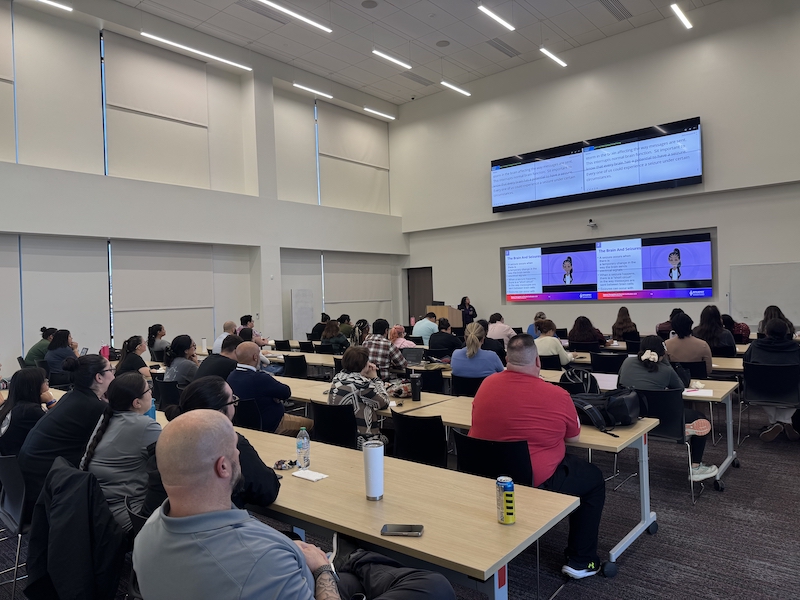
Students and faculty fill the multi-purpose room Nov. 5 in the Business Library Hall for the annual Epilepsy First Aid Training. Photo by Steven Moran
Students and faculty attended the annual Epilepsy First Aid Training Nov. 5 in the multi-purpose room of the Business Library Hall at Texas A&M University-San Antonio.
The event was hosted by A&M-San Antonio’s Disability Support Services in partnership with the Epilepsy Foundation, with the goal of teaching participants how to identify the different types of seizures and perform First aid.
“Anyone with a brain can have a seizure,” said Rita Pedraza, a representative of the Epilepsy foundation, “and anyone with a brain can help.”
Pedraza said a seizure is like a “short circuit” in the brain, where electrical signals within the brain temporarily change the way they travel between neural pathways.
According to the Epilepsy Foundation’s website, epilepsy is “a brain disorder that causes recurring, unprovoked seizures.” It is typically diagnosed when a patient has two or more seizures.
An estimated 1 in 10 people will have a seizure in their lifetime, and 1 in 26 people will be diagnosed with epilepsy, which is 3.4 million in the U.S., according to the Epilepsy Foundation.
Pedraza said seizures can have a number of causes, sleep deprivation being the leading cause among college students, but they can also be caused by brain injuries, drug or alcohol abuse, or preexisting medical conditions.
While most seizures are not medical emergencies, they can become one depending on the length and type of seizure, injuries caused by the seizure, or preexisting conditions such as pregnancy. In severe cases, seizures can lead to death, Pedraza said.
In addition to this, studies have shown that suicide rates are higher among those with epilepsy, likely because of bullying.
So what should you do when someone around you is having a seizure? Pedraza says to follow the “three S’s”:
It’s also important to remember to time the seizure, if it lasts longer than five minutes, call 911.
Do not attempt to restrain a person having a seizure. They could become aggressive and cause injury to you or themselves.
Do not attempt to give food or water to someone having a seizure, as it poses a choking hazard.
At the end of the event, students and faculty took a short, online post-exam, which if passed with an 80% or higher score, granted a certification to perform first aid in the event of a seizure.
For more information, visit the websites of the Epilepsy Foundation Central & South Texas or A&M-San Antonio’s Disability Support Services.
Event attendees were treated to cookies, courtesy of Texas Sugar Daddies. and bottled water.