Maria Hernandez
Staff Writer


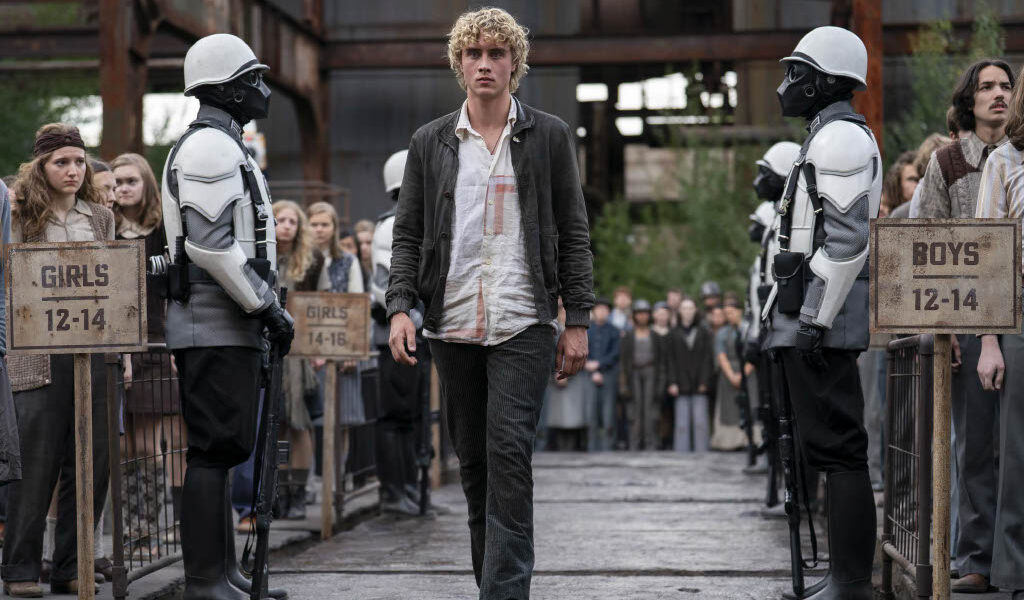
Joseph Zada as Haymitch Abernathy in The Hunger Games: Sunrise on the Reaping. Photo credit: Murray Close. Photo courtesy of Lionsgate.
“And that’s part of our trouble. Thinking things are inevitable. Not believing change is possible.”
– Suzanne Collins, “Sunrise on the Reaping”
“Sunrise on the Reaping” was released in theaters Nov. 20. The film explores the brutal 50th Hunger Games that gave District 12 its second victor, Haymitch Abernathy. In an era marked by hopelessness and nihilism, Collins challenges the viewer to imagine a better world.
This review contains major spoilers for Sunrise on the Reaping. We recommend you do not read this article unless you’ve seen the film and/or read the book.
If one word could be used to describe Haymitch Abernathy in the original “Hunger Games” book, it would be hopeless. The jaded, alcoholic cynic is entirely convinced challenging the Capitol is a pointless endeavor. “Sunrise on the Reaping” explores how Abernathy went from baby-faced optimist to a walking pit of despair in excruciating, nauseating detail.
The film doesn’t merely walk us through Haymitch’s spiral textually; every aspect of the work forces the viewer to experience dread alongside the film’s protagonist.
At 158 minutes of runtime, “Sunrise on the Reaping” stands among Collins’ similarly fast-paced works. At least, in the beginning.
As tragedy consumes our lead, Haymitch’s happy life pre-reaping feels like a blink compared with the prolonged suffering seen later in the film. Kisses shared with Lenore Dove are dwarfed in duration compared with Haymitch’s failed attempts to save his allies on the brink of death.
As the film goes on, the pacing slows. We follow Haymitch as his suffering stretches longer and longer; he loses hope and finds himself spiraling to new rock bottoms with every loss. By the end, we are left with far more empty space between lines compared with the film’s jump cuts that make the beginning feel so quick. We are left to sit with our lead in his agony, leaving no room to question why he went from starry-eyed revolutionary to disgraced drunkard.
On a critical note, the movie does skip over large portions of the book. However, I believe this can be justified. Despite time constraints keeping every detail from being included, the same major plot points are touched on. Most importantly, the abridged version given to moviegoers is just as raw and emotional.
Suzanne Collins’ greatest talent as an author is the ability to make her audience feel. The film’s sound design only strengthens this virtue.
Shortly after Haymitch enters the arena, we hear the cannon fire signaling a dead tribute and feel the weight of every blast. Eleven tributes die at the Cornucopia, and we watch as Haymitch counts, following along with each firing that makes one’s stomach sink further and further.
This is followed by a highly percussive score as we travel northbound alongside Haymitch. The drums closely mimic cannon fire, placing us in Haymitch’s shoes as paranoia lingers on the edge of our consciousness.
The in-universe songs elevate Collins’ story even further. After Haymitch returns to District 12, a funeral is held for the fallen tributes. Burdock Everdeen, father of Katniss Everdeen from the original Hunger Games trilogy, sings “The Old Therebefore.”
This calls back to Lucy Gray, the lost victor from Snow’s time mentoring, who possibly fell at his hand in “The Ballad of Songbirds and Snakes.” Every detail down to the music is crafted with intent.
While subtle, the acting in the film only packs more force into every gut-punch delivered through the screen. Kieran Culkin and Glenn Close leave audiences feeling appropriately disgusted in their flashy clothing and flanderized portrayal of America’s top 1%, while Mckenna Grace and Joseph Zada portray appropriately emotional teens placed in impossible situations.
Director Francis Lawrence took beautiful prose and turned it into equally gorgeous imagery that adds another layer of depth to Collins’ story.
One excellent example is when Haymitch is running from the volcano’s eruption, we see the flames catching up to him from afar even as he runs for his life. The audience waits in dread and anticipation until the fire finally engulfs him.
Abernathy is visually small compared with the enormity of the destruction on his heels, delivering another blow to the audience’s hope alongside Haymitch. This speaks to broader themes of hope, nihilism and perseverance throughout the film.
Together, these three elements place the audience firmly in Haymitch’s shoes. These puzzle pieces fit together seamlessly throughout the film to craft a letter addressed to a generation raised in hopelessness as the nation spirals further into despair.
It is known among fans that Collins writes only when she has something to say. The entire “Hunger Games” series was crafted as she flipped through channels and saw war coverage running back-to-back with reality television. After stepping away from the series for a decade, Collins returned to the world of Panem with a deeper look at dictator Coriolanus Snow.
Considering Collins’ political background and the nation’s growing division through President Donald Trump’s two terms, it seems fitting to see her work through the lens of modern politics.
It is no secret that Generation Z lacks optimism. Studies show that one-third of Gen Z report having fair or poor mental health, 60% feel overwhelmed by current events and less than half report they are thriving in life.
“Sunrise on the Reaping” is a direct response to this loss of hope despite its tragic nature. Haymitch loses everything in this film: family, friends, love and sanity.
He is punished severely for every transgression against the Capitol. There is an active tug-of-war between the status quo and the public interest: government and people.
Starting from his teenage years, Haymitch struggles to imagine a world where things are different. The film opens with a conversation between Lenore and Haymitch about whether things could ever change.
Haymitch is unable to consider the possibility because this is all he has ever known, much like the current generation’s circumstances. Lenore calls this mindset “faulty logic” and encourages Haymitch to shed this nihilistic worldview.
Throughout the film, Haymitch attempts to follow the light at the end of the tunnel that Lenore Dove gave him. With every loss, this light dims further until he succumbs to despair and addiction in his home. Plutarch, who would go on to become Head Gamemaker, confronts him.
“You were capable of imagining a different future. And maybe it won’t be realized today, maybe not in our lifetime. Maybe it will take generations. We’re all part of a continuum. Does that make it pointless?” Plutarch asks both Haymitch and the audience.
The narrative answers. The film ends with the sun rising on a day without a reaping, Haymitch finally able to breathe, standing next to Katniss and Peeta from the original trilogy.
It is thanks to the work of their predecessors that the next generation will never know the horror of another Hunger Games, and Haymitch is able to sit among his birds without the weight of the world on his shoulders. The ending shows that fighting for a better future is not only necessary, but leads to directly tangible results even if they aren’t achieved for decades.