Do You Know Where Your Trash Is Going?
The world’s oceans, covering more than 70 percent of Earth’s surface, are often seen as vast and resilient. But beneath the waves, a growing crisis is unfolding — one driven by human pollution that is pushing marine wildlife toward extinction. From plastic debris floating on the surface to chemical runoff settling on the seafloor, ocean pollution has become one of the most serious threats to marine ecosystems today.
What many people don’t realize is that this crisis does not begin at the coastline; it often starts inland, in cities like San Antonio.
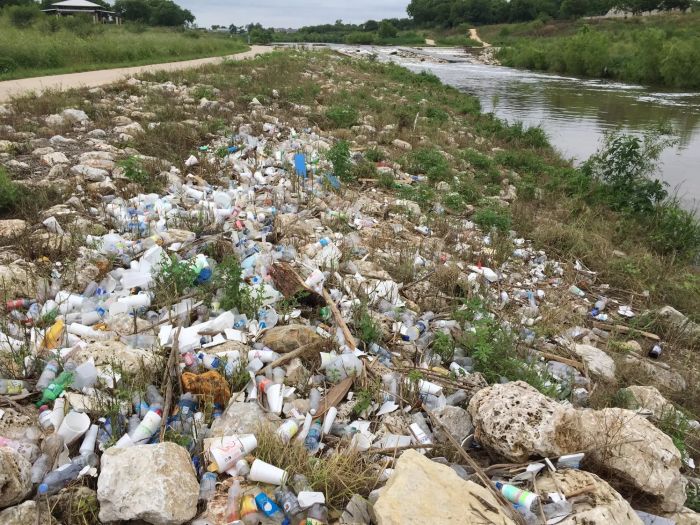
“Our city is known for the San Antonio River and the Riverwalk,” Breana Trevino, assistant marketing manager of the City of San Antonio Solid Waste Management Department on April 8th, 2026 said during an interview. “That river eventually drains into the ocean, and anything that makes its way into the river can impact ocean pollution.”
This connection between local waste and global impact highlights a critical truth: What is thrown away on city streets can travel far beyond what we see. Among the most common pollutants are plastics, especially lightweight materials like wrappers and plastic bags. These items are easily carried by wind or washed into storm drains, eventually making their way into rivers and, ultimately, the ocean. Once there, they pose deadly risks to marine life.
Sea turtles, particularly the critically endangered hawksbill turtles, are among the most affected, according to “Hawksbill Turtles in the Eastern Pacific,” according to a study published by NOAA. These turtles play a vital role in maintaining coral reef ecosystems by feeding on sponges that would otherwise overtake coral. However, plastic bags often resemble jellyfish, their natural prey. When ingested, plastic can block their digestive systems, leading to starvation or death. Many turtles also suffer from entanglement in discarded fishing gear, which can cause severe injury or drowning.
Pollution does not stop with turtles. Coral reefs, the foundation of marine ecosystems, are also under threat. Chemical runoff, oil spills and plastic waste damage reef environments, killing the coral polyps that support thousands of marine species. As reefs decline, entire ecosystems begin to collapse. According to “What is a Coral Reef?” published by NASA, coral reefs provide shelter, food and breeding grounds for countless dives marine organisms, making them one of the most critical habitats in the ocean. When pollution weakens or destroys the coral systems, first population declines, biodiversity decreases, and coastal communities lose natural protection from storms and erosion. Scientists warn that once coral reefs are severely damaged, recovery can take decades, and in some cases, full restoration may never be possible.
Meanwhile, the vaquita porpoise, found only in the northern Gulf of California, has been pushed to the brink of extinction, with fewer than 10 individuals remaining, according to the World Wildlife Foundation. While illegal fishing is its primary threat, pollution and marine debris worsen its chances of survival.
In San Antonio, efforts to prevent this type of damage begin at the community level. According to Trevino, one of the city’s strongest tools is education.
“Reducing pollution starts at home by removing the barrier of recycling intimidation or confusion,” she said. “The more informed people are about how to dispose of items properly, the more participation we have in recycling and organics programs.”
The city offers services to help residents manage waste responsibly, including:
- curbside collection for recyclables and bulky items
- drop-off centers for hazardous waste
- outreach programs that provide education to all age groups, from kindergarten students to college campuses, helping build long-term environmental awareness
In addition to prevention, San Antonio also addresses pollution through cleanup efforts. Illegal dumping remains a significant challenge, particularly in vacant lots and hidden areas.
“Our illegal dumping crews are out there daily,” Trevino said. “In FY 2025, they collected waste from over 12,000 locations across the city.”
Items such as furniture, appliances and construction debris not only degrade the environment but can also break down over time, releasing harmful substances into soil and waterways. These pollutants can eventually make their way into larger water systems, continuing the cycle of contamination.
Despite these efforts, challenges remain. Illegal dumping requires both enforcement and community cooperation.
“It is not a victimless crime,” Trevino said. “We encourage residents to report illegal dumping and take advantage of proper disposal resources. The more we work together, the more we can protect our environment.”
San Antonio has worked to improve its recycling process. The city services approximately 380,000 single-family households and partners with a materials recovery facility operated by Circular Services. Opened in 2024, the facility uses advanced automation to sort and process recyclable materials efficiently.
Because the facility’s revenue depends on selling recyclable commodities, there is a strong incentive to ensure materials are properly processed rather than sent to landfills. According to Trevino, this system helps maximize recycling effectiveness and reduce overall waste
With Earth Day approaching, this issue becomes even more important to recognize. Earth Day serves as a reminder that protecting the planet does not only happen through large-scale policies or global movements, it begins with everyday choices made at home and within our own communities. In a city such as San Antonio, where local waterways eventually connect to the ocean, simple actions such as recycling properly, reducing plastic use, and preventing illegal dumping become acts of environmental responsibility.
Still, experts agree that individual action remains one of the most powerful tools in addressing pollution.
Ocean pollution may seem like a distant issue, but its roots are often much closer to home. Every piece of litter, every improperly discarded item, has the potential to travel through waterways and contribute to a much larger environmental crisis.
The ocean may feel far away, but it is connected to us all. Earth Day reminds us that protecting marine life starts long before the shoreline. And the question remains: Do you know where your trash is going?