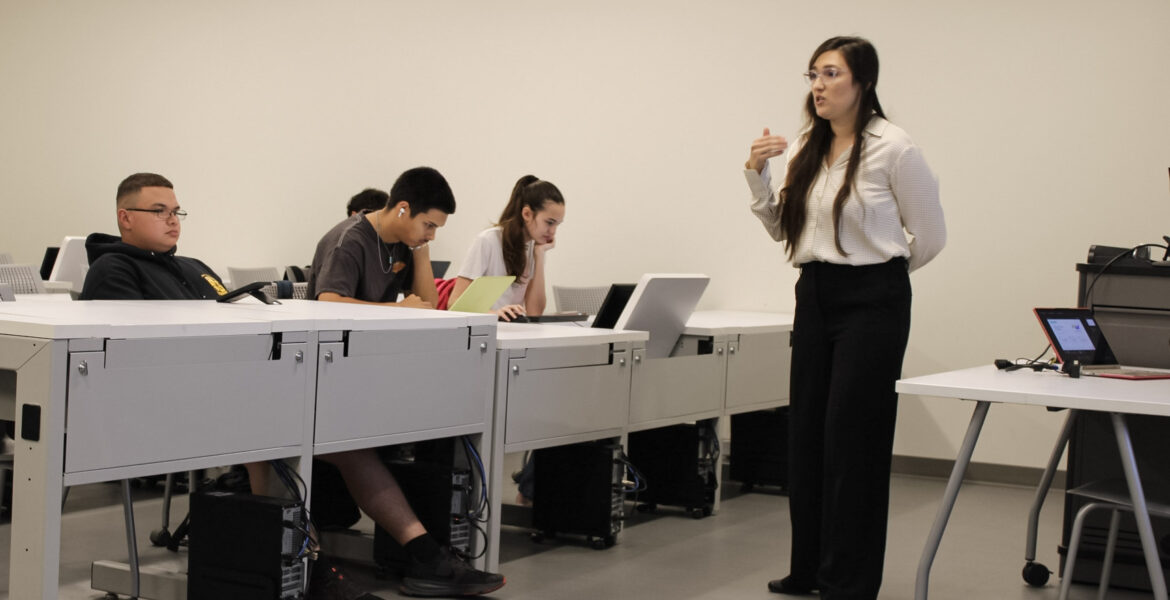
The Department of Computational, Engineering and Mathematical Sciences plans on making some big changes, including three new degrees, all within the span of a few years.
The department has hands-on programs where students can learn new skills and apply them in class to help them land jobs in the future.
The university is hoping to add three new bachelor’s degrees between 2027 and 2030 to keep growing the engineering field on campus: electrical engineering, construction engineering technology and computer engineering.
Katherine Gillen, interim dean, College of Arts and Sciences, described what inspired Texas A&M University-San Antonio to expand the program.
“There has been encouragement from the Texas A&M System and even from the legislature to develop engineering programs…our area would benefit from engineers… and engineering programs would attract more students to the program,” Gillen said.
The engineering programs offered right now are Cyber Engineering Technology and Electronics Systems Engineering Technology (ESET).
University officials hope to add an electrical engineering degree next year.
“We’re getting ready… to teach engineering at the school and build a strong viable engineering program that will provide students jobs in this region…It’s a big part of our mission,” department chair Venki Uddameri said.
The process of adding a new program usually starts with proposals from faculty members, but since the university doesn’t have faculty from these programs, outside help from other institutions was required for consulting about these programs before the proposal was made.
Once reviewed by the faculty here it went though the curriculum process, then to the Board of Regents for approval and now to the Texas Higher Education Coordinating Board. Some of these programs would have to go through the Southern Association of Colleges and Schools for accreditation.
Debra Feakes, interim provost and senior vice president for academic affairs, said the new degrees will help attract and retain students.
“We know we are losing students who come here or are interested in coming here, but then they find out we don’t have engineering fields,” Feakes said in a Zoom interview.
Construction engineering technology would be added in 2029.
This would be another hands-on program for students to get real-world experience in the construction field.
“I think that degree will be a really popular degree,” Feakes said.
With the amount of construction in the area it will draw more people to the university for this future program in particular.
The program would also follow what is known as a ‘Design Spine Model’ just like the other engineering technology programs.
The model means that the students will be doing more hands-on work throughout all four years versus doing all the lecture-based courses and having a project only in their senior year.
This allows them to grow and evolve in the field and gain real-world experience as they’re taking classes.
Computer engineering would be the third degree program added in 2030, which would be a more theoretical and lecture-based program.
With new changes coming in the near future, the department would need a new configuration, but what that would look like is still unclear.
“Maybe there will be a request at some point for another building that would serve engineering,” Gillen said of future aspirations.
All of these programs still have to be approved for funding from the Texas Legislature.
The funding request was submitted to the Legislature Sept. 25.
Feakes reached out to the university President Salvador Hector Ochoa to ask what would happen if the Legislature doesn’t approve the funding for these programs.
“We are hopeful that the Texas legislature will be supportive of these important high-demand programs,” Ochoa wrote in a statement. “However, if funding is not approved during this legislative session, we will explore alternative routes, which may include expanding our implementation timeline.”