Rolando Morales
Managing Editor


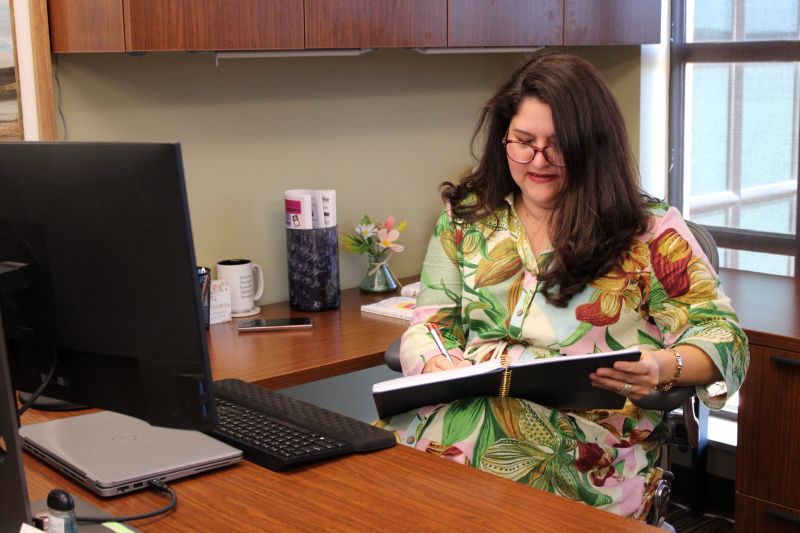
Griselda Aguirre-Garcia, a doctoral student in educational leadership, takes notes in her office Oct. 22, 2026 at Texas A&M University-San Antonio. She is one of 17 students enrolled in the university's Doctor of Education in Educational Leadership program. Photo by Makayla Bass.
A cohort of 17 students is pursuing a Doctor of Education in Educational Leadership with Superintendent Certification at Texas A&M University-San Antonio, focusing on practical, marketable skills and real-world applications in education.
The group is enrolled in two courses: EDAD 6301, Leadership in the Pursuit of Excellence, and EDAD 6350, Introduction to Education Research.
The cohort includes teachers, assistant principals, principals, associate superintendents and superintendents. Many are already planning their dissertations, which will focus on research to support educational change throughout Texas.
Classes meet online two nights a week, Tuesdays and Thursdays, from 5:30 to 8:15 p.m. During the day, students work in their respective schools, where they can apply the skills they learn in the doctoral program to their current positions.
The program was established by Sean Kearney, a professor of educational leadership in the Department of Educator and Leadership Preparation and former director of principal certification; Lawrence Scott, an associate professor in the department; and Elisabeth Krimbill, an associate professor of educational leadership. They worked with faculty in the department, led by Esther Garza, a professor of bilingual and ESL education and the department chair.
The Ed.D. in Educational Leadership prepares Transformative System-Level Leaders through a multidisciplinary curriculum that provides graduates with the knowledge and skills needed to lead educational organizations and collaborate within their social and cultural contexts.
Kearney and Krimbill teach courses in the program.
“This degree plan is designed around an action-oriented ‘dissertation-in-practice’ approach,” Krimbill said. “Students will identify a problem of practice (PoP) in their research courses and design individual studies to collect data in response to an identified research question under their elected specialization of systems-level knowledge.”
Students will develop skills in:
According to Krimbill, the 54-credit program is divided into three areas: 18 credits focused on research methodologies, 18 credits toward superintendent certification and 18 credits in educational leadership, where students study current research on leading schools.
Krimbill also referenced the Texas Higher Education Coordinating Board’s 2022-30 60×30 Strategic Plan, which notes that Texas has the ninth-largest economy in the world.
“The state is considered an established global leader, driven by the success of our increasingly educated workforce,” Krimbill said.
The strategic plan calls for Texas institutions of higher education to expand opportunities for Texans to earn degrees, certificates and other credentials.
“I could tell you we had more than 60 applicants for a cohort of 15 students, so it was a very rigorous application process,” Krimbill said. “And the pool of applicants were all really quite spectacular and amazing. Many of them are alumni of A&M-San Antonio.”
Students will base their dissertations on a problem of practice, analyze data from their own school or district, and develop a study intended to improve students’ educational opportunities or benefit their communities.
“They will become experts on their research and transformative leaders in their community and districts,” Krimbill said.
Griselda Aguirre-Garcia, an education doctoral student, said hearing the experiences and perspectives of other students in her cohort has been enlightening and helpful.
“It’s been very enlightening and insightful to hear from the other people in our cohort about how they think about education and the problems that we see happening right now.”
Aguirre-Garcia said she has also learned that gathering information for research involves protocols, approval processes and strict guidelines.
“So there’s actual protocols and processes when you’re doing research that you have to follow, like strict guidelines, “ Aguirre-Garcia said, “and you need to ask for approval by this governing board and body of people to give you permission”
She has also learned to look at problems through different perspectives, a skill she has been practicing in her job at the Mays Center.
“It actually expands your mind and amplifies your thoughts about what you’re looking at, what you’re studying,” Aguirre-Garcia said. “What the problem really is, and how complex it could be and then it’ll enlighten us to be able to explore solutions.”
For Aguirre-Garcia, one of the easiest parts of the program is having direct access to professors who are available to help students.
“Easiest is access to the professors-they’re always available and helpful, very helpful. So that’s the easiest part,” Aguirre-Garcia said. “We know who our professors are. We know how to reach them. They’re very available, very accessible.“
Balancing the program with her other responsibilities has been more challenging.
“The hardest part is managing my time, because I do have a full-time job, and I am a mom with two high school students, and they have a full life of evening activities and things that they need.”
Despite those challenges, Aguirre-Garcia said pursuing her doctorate is manageable with flexibility and prioritization.
“But it’s definitely doable. You just have to change what you do on which days,” said Aguirre-Garcia. “You kind of have to look at it like a game of Tetris and move things around. If nothing changes, nothing changes,” Aguirre-Garcia said.