Trinity Hewtty
Editor-in-chief



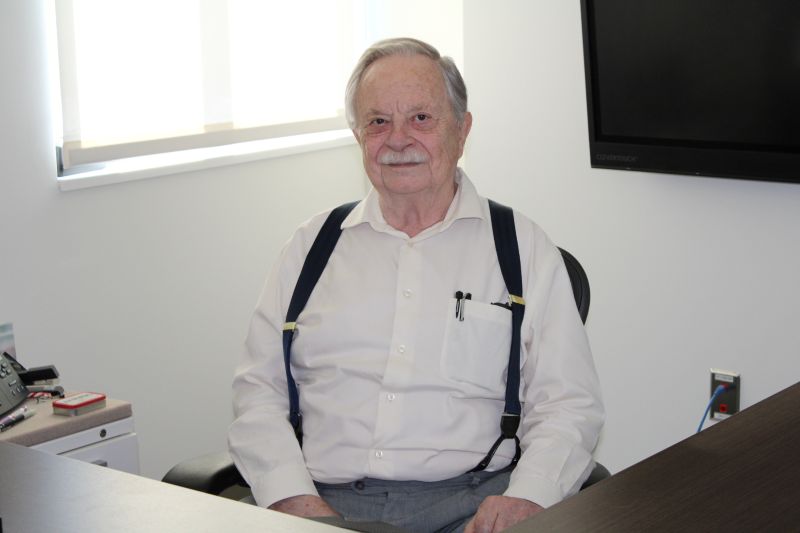
Richard Green, chair of accounting and finance department at Texas A&M University-San Antonio Nov. 10, 2025. Photo by Trinity Hewtty.
Long before he became the department chair for accounting and finance at Texas A&M University-San Antonio, Richard Green never imagined a future in aviation or education — until an opportunity arose while he was a teenage sign maker, sending him flying across the world and, eventually, into becoming a respected educator.
“Each new venture excited me at first, but I was always looking for the next challenge,” Green, 81, said.
A longtime colleague, Dennis Elam, associate professor of accounting and finance, highlighted Green’s ability to blend his business experience with accounting in his teaching career.
“Green is a thoroughly experienced individual, both in the real world of business and in the world of academics,” Elam said.
Takeoff
The Missouri native’s career began at 13, working as an apprentice to a glassblower in a neon sign shop.
“I learned to make neon tubing and how to paint signs by hand,” he said, reminiscing while leaning back in his office chair during an interview Oct. 14.
The experience gave him the knowledge to own businesses in the electrical sign and construction industries.
Green supported himself through college by erecting signs for different companies. He worked for $2 an hour on the interior signage for Katz Drug Store, a retail drugstore that sold groceries, cosmetics and household goods at a time when it was not common — revolutionizing the shopping experience even before Walmart came along.
He graduated from Missouri State University in 1964 with a bachelor’s degree in secondary education.
However, a twist of fate occurred when “a fellow who owed me a lot of money” started a flying school and offered him lessons to cover his debt, as long as Green paid for the fuel.
“It was unfortunate the guy owed me money — neither of us had any knowledge of accounting or finance,” he said. “I simply did not understand that the money he owed me was gone and I couldn’t get it back. But he offered to provide me with flight instruction in his airplanes if I would just buy the gasoline that the airplanes were burning.”
This was the beginning of what he describes as a career flying “motorcycles with wings.” He sold his sign business and started giving flight instructions at Olathe Municipal Airport in Kansas until 1966.
That same year, he was hired as a flight engineer at the Kansas City airport on a Boeing 727, which could seat about 200 people and had a maximum takeoff weight of 152,000 pounds. He was eventually promoted to co-pilot, flying a two-engine jet called the Douglas DC-9.
During his tenure with Trans World Airlines, he was selected for a special military operation that transported soldiers and gear in the Vietnam War, flying between airports in the United States, Europe and Asia.
“Of course, going to Vietnam was really hot at the time. We were flying mostly into Saigon,” Green said. “But I was never in the military, so I never saw any kind of combat. I just flew the 707 for several years until we had a big recession and all the airlines started cutting back.”
Green said it was his favorite flying experience, but he lost his captain position when the recession forced cuts within the industry.
However, he continued to fly as a co-pilot, transporting cargo across the world and piloting passenger aircraft.
“I lost my captain’s position, went back to co-pilot the Boeing 707, lost that position, then went back to co-pilot the Boeing 727, and then lost that position,” he said. “So I went back to co-pilot on the Douglas DC-9 and I flew that for another couple of years or so. Ultimately, things started to turn around at the airport.”
The airline eventually recovered financially, giving him the chance to fly the biggest airplane of his career, the Boeing 767-300.
“It was about a 240- to 250-passenger airplane with twin engines and aisles,” Green said. “That was the biggest airplane I ever flew, and I was flying the 767 right up until 1999 when I retired.”
Liftoff
Before retiring, he returned to school to become an accountant — a choice heavily influenced by being in his 40s.
“It was a rational decision,” he said. “I was not just gonna get any job at my age. It was not gonna happen and I did not want to continue flying airplanes.”
Green could have taught with his bachelor’s degree but turned down that idea. He also passed on an opportunity with NetJets, which he described as being “a very highly paid chauffeur for rich people,” flying the Gulfstream, the most expensive business jet in the world.
Instead, he completed his master’s degree in accountancy and passed the CPA exam at 49, all while still piloting and working for Ernst & Young as a licensed accountant.
Simultaneously, he also was a contract consultant for Land O’ Lakes and other startup companies internationally – completing projects in land analytics.
”I did a modernization plan for this company in Maracaibo, Venezuela,” he said. “I did that plan and we built the plant, got the equipment in and got it running the same year that Hugo Chavez was elected. Of course, we had to leave when Chavez became president, and I’ve never been back since but I loved it.”
In 1992, he continued to pursue his education and began a doctorate program in business administration at St. Louis University and accepted a two-year visiting position after realizing Trans World Airlines was headed toward closure.
“There was no doubt in my mind under the new ownership that it was on its way out, so I took the position,” he said.
Green remained in the role for two years, commuting from St. Louis to San Antonio because his wife and son were living in the Alamo City. When his contract ended in 1997, he became an associate professor at the University of the Incarnate Word, where he taught for six years.
At the same time, Green served as co-chief executive officer for Azteca Airlines in Mexico City, helping create its business plans. He and his colleague managed the company’s airplane leases for two years.
During the interview in his office, Green begins to rummage through boxes on his shelves looking for the business plan as he details the experience of having to commute between two countries while handling duties as a professor and CEO.
“I commuted back and forth because I was teaching at UIW for two days a week,” he said. ” So I would come back on Monday so I could teach on Tuesday and Thursday and then leave that day to go back down there. It was fun and a real kick to do. We got the first four airplanes leased, when the owner decided he could replace us with highly qualified Mexican pilots and business people for less than half what he was paying us.”
He managed both positions — teaching and being an executive — while also helping his wife run a bed and breakfast.
Green later moved on from both the airline and Incarnate Word, eventually teaching at Webster University for a year.
Landing
In 2008, Green joined A&M-San Antonio — then called the Service Center of A&M–Kingsville — as an associate professor of accounting and finance.
“I met Tracy Hurley, who was the dean of business at the time, and Maria Ferrier, the first president of this university,” Green said. “The two of them together convinced me I should come, even though it was a little less money than I had been earning. I thought it would grow, and I was not in a hurry, so I have been here ever since.”
As the department chair, Green works to accommodate the faculty’s needs and provide good leadership, said Taegoo Kang, associate professor of accounting and finance.
“In my beginning year in 2017 as a professor, he gave me a lot of advice on teaching and guided me in my role,” Kang said.
Elam said that outside their working relationship, Green keeps him entertained with his stories when they travel together.
“We have traveled to Houston and to conferences together,” Elam said. “I mean, Richard is great to work with and an interesting travel companion because he’s literally been everywhere. I mean, India, Egypt, Paris — you name it and he has been there. He especially keeps me entertained with all his great travel stories.”
After 68 years of stories, Green will officially retire this December with no definite course for his next adventure. He said he may travel with his wife to places they’ve never seen — Glacier National Park, Australia or New Zealand — but for the first time in his life, he only has one certain plan in mind.
“I plan to do nothing — absolutely nothing,” Green said.