
Erik Estrada
Editor-in-chief



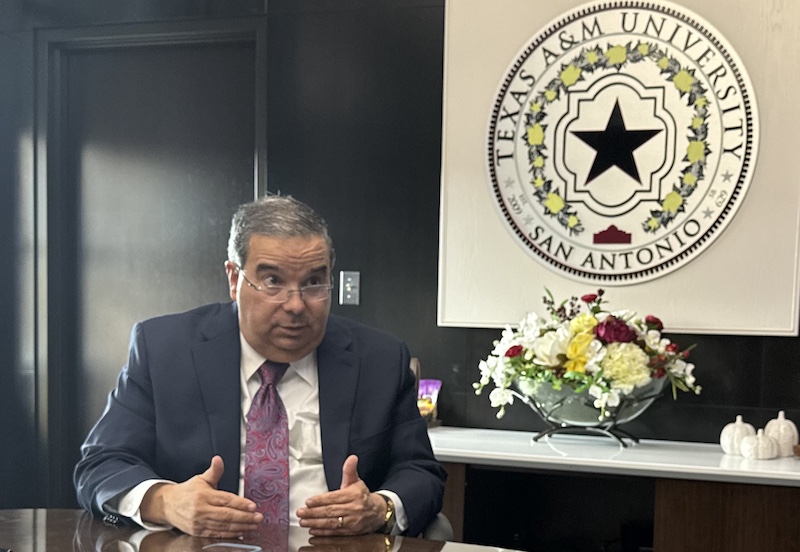
Texas A&M University-San Antonio President Salvador Hector Ochoa in a meeting with editors from The Mesquite on Oct. 8, 2025. Photo by Erik Estrada.
Uncertainty looms as A&M System-wide audits unfold in the wake of a controversial faculty dismissal.
The Texas A&M University System has called for course audits across all 12 A&M universities in a post on X following the dismissal of a Texas A&M-College Station professor whose children’s literature course included discussions of gender identity. The move has raised questions among faculty about transparency, academic freedom and the audit process.
At Texas A&M University–San Antonio, faculty and administrators have yet to receive detailed information from the System about how or when the audits will be conducted.
“As the chancellor said, there will be system-wide audits about courses and what is taught in them,” said Salvador Hector Ochoa, A&M-San Antonio president. “We’ve received no guidance from that, so I can’t speculate what that will be or what will be involved. Once we get that, we will work with our faculty and inform them so they understand ahead of time what we’re doing.”
Ochoa said the administration plans to communicate with faculty once additional details are released from the A&M System, to ensure instructors are supported and aware of expectations.
“What I’ve learned with faculty is that not knowing causes concern,” Ochoa said. “But taking the time to visit with them goes a long way. So as soon as we do that, I’ll meet with the deans, the chairs and the faculty and say, ‘This is what we’re required to do.’”
According to the A&M University System Audit Office website, its mission is to “provide independent, objective assurance and consulting services designed to add value and improve the A&M System’s operations.” The department reports directly to the Board of Regents and the Chancellor, with authority to access all System records and functions. Its responsibilities include developing and executing annual audit plans, investigating allegations of fraud and evaluating the effectiveness of risk management and governance processes.
After requesting details from the A&M System Audit Office, The Mesquite was referred to the department’s online Mission and Responsibilities page for information about its role and scope.
Faculty members, however, remain uncertain how this authority will apply to the new academic audits and whether the reviews will extend into course content or instruction.
“That’s a good question, and I don’t know, and I’m not sure anybody knows,” said Daniel Braaten, political science professor and president of the A&M-San Antonio chapter of the American Association of University Professors. “The president and provost said they have not received any information from the System about what they will entail or when they’ll happen. We’re pretty much in the dark on this.”
Braaten said the AAUP wants to ensure faculty are included in any review process to preserve shared governance and academic freedom.
“If these audits are going to happen, faculty should be involved in the process,” Braaten said. “It shouldn’t be something determined solely by administration or the System.”
In a statement, the AAUP and the Texas American Federation of Teachers condemned the removal of children’s literature professor Melissa McCoul, calling it “the clearest example yet” of political interference in higher education.
“It is appalling that a university professor, her dean, and her department chair have been removed from their positions based on viral video clips and an online outrage machine stirred by state politicians and the governor himself,” the statement read.
The group argued that recent legislation, including Senate Bill 37, which dismantled faculty senates statewide, and Senate Bill 18, which altered tenure policies, has chipped away at academic freedom and could drive faculty and students to leave Texas institutions.
As the A&M System continues to develop the audit process, both administrators and faculty at A&M–San Antonio say they share a goal of transparency but for now, they agree that everyone is still waiting for answers.