Trinity Hewtty
Editor-In-Chief



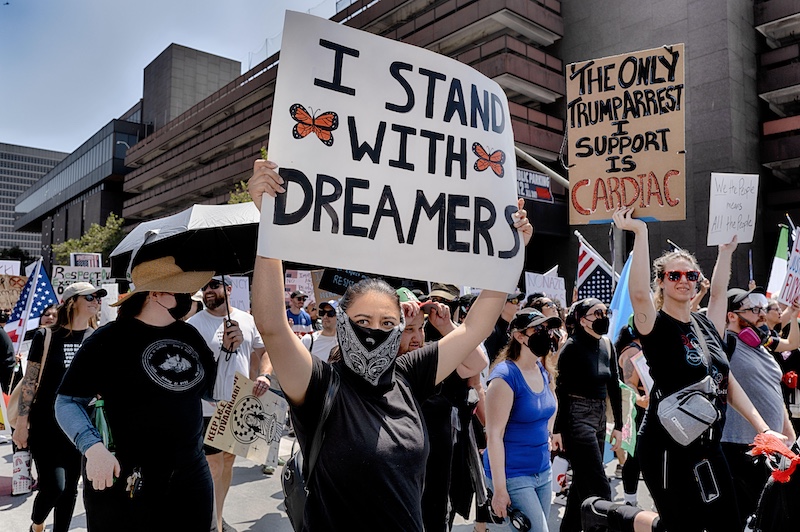
A protester carries a sign that reads "I Stand with Dreamers" during a "No Kings" protest in downtown Los Angeles on Saturday, June 14, 2025. (AP Photo/Richard Vogel)
This summer, computer science sophomore Obed Valencia learned he would no longer be able to afford to attend Texas A&M University-San Antonio.
The Texas Dream Act, which qualified undocumented students such as Valencia for in-state tuition, was reversed, increasing educational fees. Texas Attorney General, Ken Paxton, and the United States Justice Department filed a complaint claiming the act was unconstitutional — a federal judge repealed the claim within six hours.
“When I saw the news, I thought maybe it was gonna take some time to go into effect,” Valencia said.“It all happened so fast, my tuition bill doubled and then my financial aid got taken away. It was all very hard to understand. It was a lot of sadness, anger and frustration.”
At Texas A&M-San Antonio, only 48 undocumented students returned to campus out of 103 from last semester.
Valencia was unable to return to school after his tuition went from $5,000 to $10,000. Born in México, he came to the United States with his parents at the age of nine-years-old to escape cartel activity rampant in the city. He said his family sought to establish a better life for themselves in the U.S.

Although some students like Valencia are no longer able to receive financial assistance. Other returning undocumented students obtained an academic excellence scholarship through the organization called The Dream.US.
The Office of Financial Aid and the Dreamer Resource Hub identified a way through The Dream.US scholarship that provides supplemental support for those students, Maria Andrade, president of the Dreamer Student Organization, said in an interview Sept. 15 on Zoom.
Andrade, a business management junior, said the Dreamer Resource Hub and Financial Aid worked closely together to ensure some Dreamers could receive in-state tuition to continue their education.
“The scholarship awards certain recipients and they get in-state tuition per semester,” she said. “Thankfully, a lot of the recipients that applied received it. They’re trying to continue it as a perpetual thing going forward.”
Around 60 students — mostly, juniors and seniors — received the scholarship. The minimum that can be awarded is $1,000 each semester.
The university’s Dreamer’s Resource Hub declined to respond to interview requests.
Multiple attempts were also made to reach the Office of Financial Aid for comments with no response.
The Mesquite interviewed three current and former students who have been affected by the act’s removal. Two of them requested to remain anonymous for fear of their safety because of the current political climate.
A returning psychology senior said the scholarship gave them what they needed to cover their entire tuition to finish their last semester.
”It was only $1,000, but thankfully with the money left over from a previous scholarship my tuition was all covered,” the student said.
Even though they have the opportunity to complete their education, there is still the dilemma of their undocumented status, which can hinder them from gaining a job after graduation.
“ My hope is just to do anything that works with children,” the psychology student said. “I used to wanna become a teacher. But I think with my status, it’s been harder for students like me to be able to work in that field.”
The psychology student is also thankful to the Dreamer Student Organization for its unwavering support.
“The organization itself has taken a lot off my shoulders, and it feels like I’m not doing it alone,” the student said. “I have people who are cheerleaders for me. They’re just like this constant support system that is really well needed during these hard times.”
For a former A&M-San Antonio business administration junior who requested to not be named, the support from the Dreamer Student Organization makes them still feel included in their community.
“When there’s news going on, they are the ones that keep me updated.” the former student said. “I always see the Instagram posts. They’re always trying to be helpful. It’s always nice to know what’s going on with my community, how it’s changing throughout time, and it just keeps me informed.”
Although the former student left the university as a result of the increased tuition costs, they do not want to rely completely on scholarships to help fund their education nor attempt to get a loan.
“If I can go back to scholarships, that would be great,” the former student said. “But I don’t really want to rely on that too much. I want to help my own education and fund it.”
According to the university’s tuition and fee calculator for 12 credit hours in-state tuition costs around $4,000 while out-of-state tuition ranges over $9,000.
The Dreamer Student Organization is trying to inform undocumented students like Valencia about other resources that The Dream.US organization offers besides scholarships.
“They are hosting a lot of fellowships right now,” Andrade said of The Dream.US. “They posted on their Instagram some resources for virtual jobs and remote jobs that don’t require experience and are looking for new hires.”
The Dream.US is also working to establish a partnership with universities to help undocumented students finish their education through either an online program or private university. Valencia wants to wait for when the organization is able to provide these options but is open to other opportunities.
“But I still don’t really have a clear decision when it comes to my education,” Valencia said. “That’s constantly changing. I never expected to go to college because of my legal status here. So I’ve kind of just learned to go wherever the wind takes me. That’s really the only thing I can do right now is just move on and look for better opportunities elsewhere.”
The Dreamer Student Organization hopes undocumented students know that they are still on campus advocating for undocumented students.
”We’re testing the waters by hosting social events to see how many people are willing to go,” Andrade said. “We’re also trying to see how many people are trying to be more active, or if people want to take a step back. Which is completely fair and fine. I just think that they should know they’re not alone, we’re here for them and we’ll continue being here for them to advocate for their rights.”
Valencia said he appreciates the Dreamer Student Organization going out to educate people. He hopes their message will continue to teach those looking from the outside perspective to have compassion towards undocumented immigrants.
“It’s really crazy how people don’t really know what a Dreamer is,” Valencia said. “I would talk a lot about Dreamers on campus, and no one really knew what I was talking about. I just want people to feel compassion and understand it wasn’t really my decision to come into this country as a child, but this is the reality that I’m stuck living. I’m just a college student.”
Editor’s Note: This story was updated to correct a paraphrase that used the word “loophole.” It now reflects the accurate wording.